Integrated Management Systems (IMS) for environmental consultancies.
The certification badge is the least valuable thing you’ll get from an IMS.
Most consultancies start the IMS journey with the goal of obtaining certification, but the real value lies elsewhere:
The exit multiplier
Buyers pay for firms that run without their founders. A system that holds quality on its own is the difference between a 2× EBIT conversation and a 6× one.* We advise on consultancy M&A, so we know what buyers discount.
Quality, standardised
Every office, every author, every deliverable to the same standard ,so the quality of the work stops depending on which team did it, and new staff and new offices start on the firm’s footing, not their own.
Tacit knowledge, captured
McKinsey loses a fifth of its people every year and gets smarter anyway, because what they learn is written into the firm before they leave.† Product templates and lessons registers do the same job here.
Product-level quality
A definition of what good looks like for each service you sell, built into the templates the work starts from. Quality becomes a property of the product, not the person.
The ratchet
Corrective and preventive actions turn every complaint, near miss and audit finding into a permanent fix rather than a repeat. The system only moves one way: better.
Officer duties, discharged
WHS law places due-diligence duties on you personally as a director. A system doesn't discharge them — but a well-run 45001 system structures the steps that do, and records them.
Our Solution
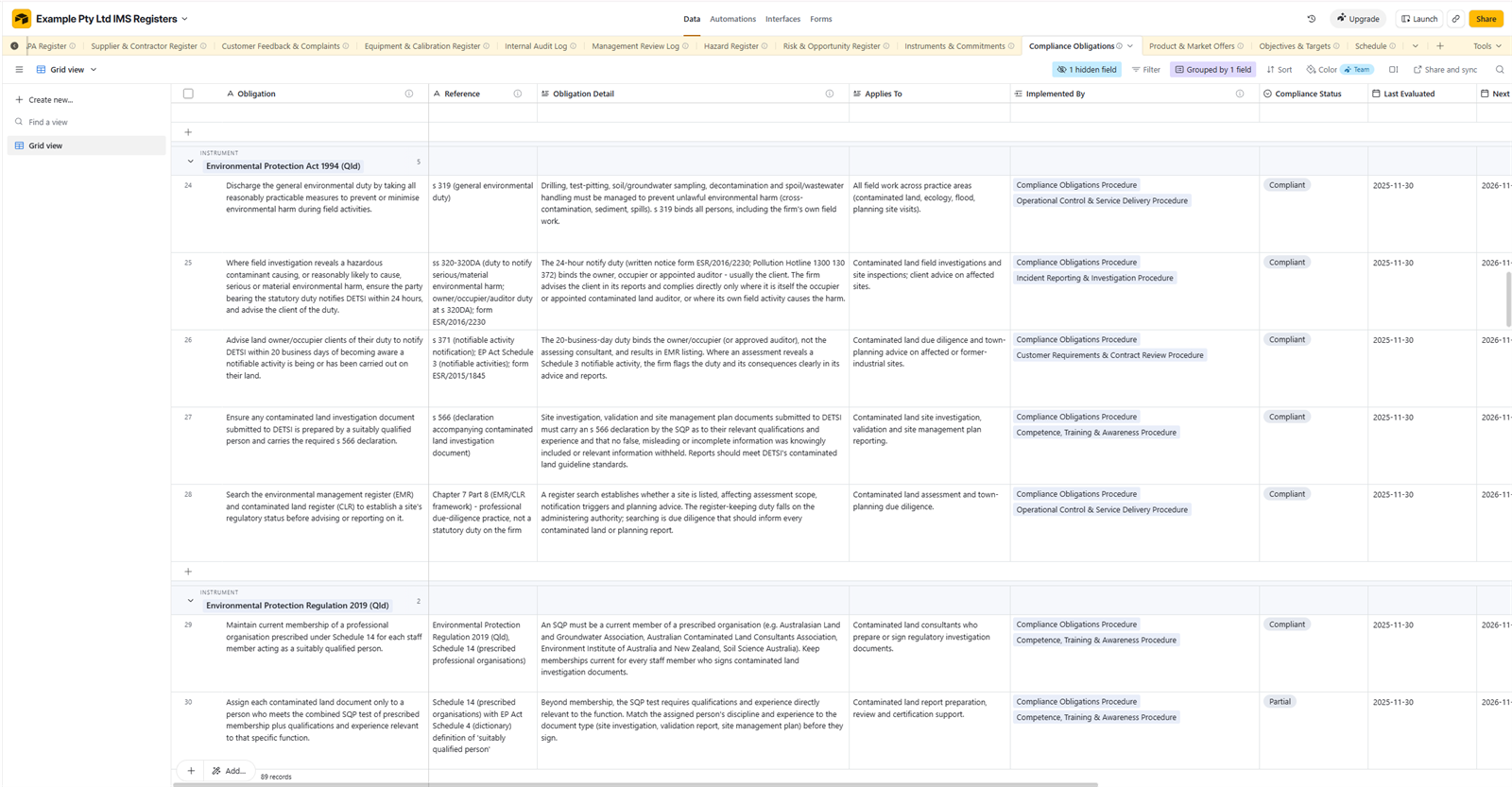
We interview you and your key staff to learn how the firm runs, then present that understanding back to you for correction before anything is written. We build the system on it and deploy it to your own GitHub. We populate the registers: legal obligations, hazards, risks, audits and actions. Then it is yours.
What you get
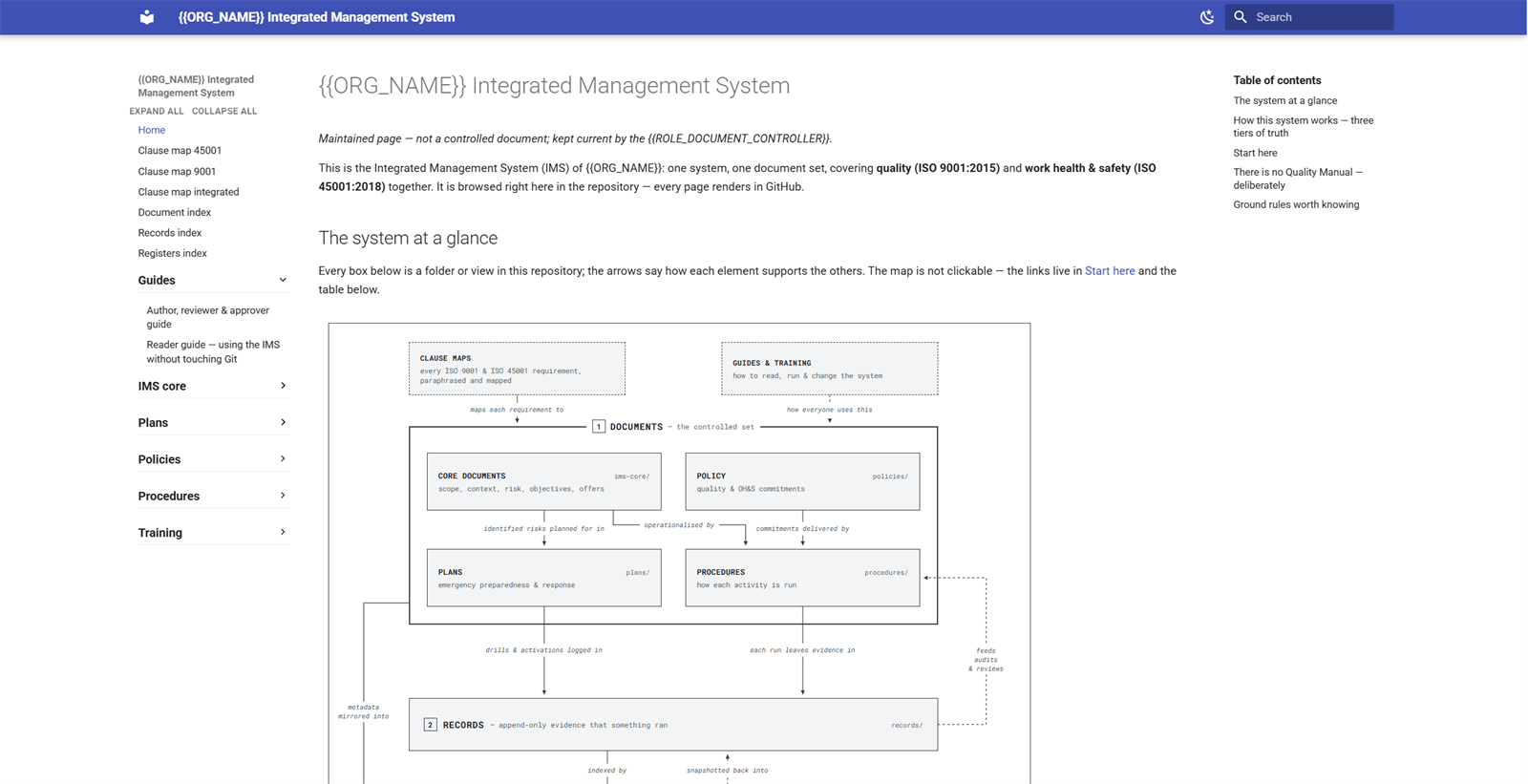
The drawing below is the system you get. To see what it looks like deployed, the template IMS is a live copy you can browse.
Features
The IMS ships as a staff intranet, deployed to your own GitHub. Four features that a folder of templates cannot give you:
Intranet-based
Every procedure, template and register is a page: one current version, searchable in seconds, linked to the clauses it satisfies and the records it produces. Staff land on the pages relevant to their role, not forty Word documents in a folder tree nobody opens.
Your infrastructure
We deploy the IMS to your own GitHub organisation. No SaaS subscription, no per-seat licence, nothing that stops working the day you stop paying a vendor. The system is yours to own.
Opinionated
The processes come already written to best practice for environmental consultancies, so you are not designing a management system from scratch. Where you have a gap, we build the control with you rather than handing you a blank template.
Leveraged
You inherit assets built across every system we run: a shared legal and other-commitments register kept current for the sector, and risk insights drawn from other consultancies’ experience, anonymised. Your risk register learns from more than your own incidents.
Delivery Timeline
From gap analysis to audit-ready in two weeks.
Gap analysis
A short, fixed-fee review of how you deliver work today against the standard. You get the roadmap either way, and the fee is credited against the build.
System build
Staged drafting with your team in the room: policies, processes and records that match how projects actually run, published to the intranet as they land rather than landing in one pile at the end.
Implementation and internal audit
The system goes live, your people are trained on the parts they touch, and a full internal audit shakes out the gaps before anyone external sees it.
Certification
We coordinate quotes from accredited certification bodies, sit beside you through Stage 1 and Stage 2, and close out any nonconformities at our cost.
Pricing
Three ways to run the system, from free templates to a managed programme. Figures shown are for the smallest firm: one service line, up to ten staff, one office. DIY and Guided are flat at any size; Managed scales from here, and the pricing page prices it for yours.
Who we help
A good fit
Australian environmental consultancies with 7+ staff and aspirations of growth and expansion, winning work through tenders, panels and prequalification.
People in the field. Safety managed in a structured way, because your duties as a director are personal.
Directors who want the scaffold. A system to train new staff, open new offices and hold quality steady as the firm grows.
Any stage of the cycle. First certificate, stale-system rescue, outgrown manual, or handing the quality-manager role to us.
Better served elsewhere
We’d rather point you at the right help than sell you the wrong fit.
Outside environmental consulting. Manufacturers, builders and operators deserve a consultant who knows their industry the way we know ours.
A tick in the box at minimum spend. Take the free template and self-serve. If you ever want to leverage the system as a scaffold for growth, we're here to help.
Big enough for an in-house quality team. At 500+ headcount you want a full-time quality manager on payroll, and we’ll gladly hand over to them.